 Image 1 of 1
Giving hope to a world torn apart
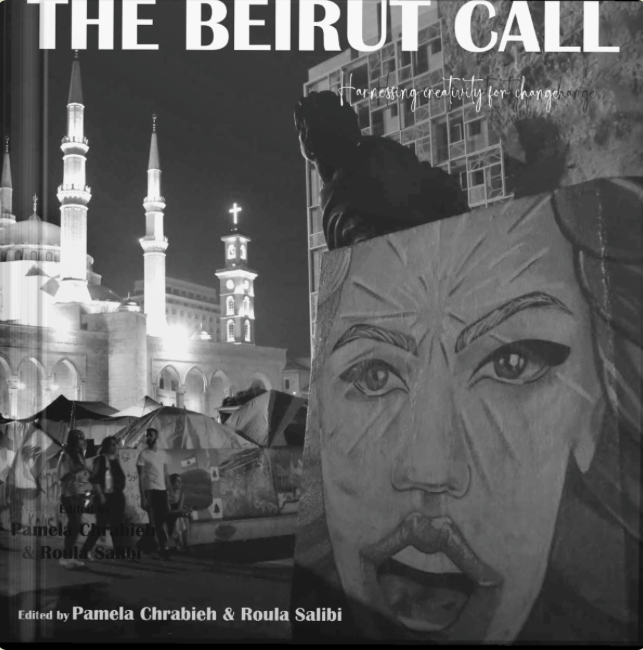
The Beirut Call is an anthology of essays, poems, artwork, and photographs from over 20 contributors who explore the concepts of devastation and resilience. When the Beirut port exploded in August of 2020, it shattered more than buildings and homes: it reopened wounds, grief, and fears that many had experienced during the long and brutal Lebanese civil war. Loss of life reached the hundreds and injuries numbered in the thousands.More than 300,000 people were left homeless. In addition to this devastation, the people experienced the loss and destruction of parts of it’s art center, including the Sursock Museum, The Arab Image Foundation, the Sfeir-Semler Gallery, and the Beirut Art Center.
How does the act of witnessing hardship and molding powerful art change the landscape of local and global hardship? In this anthology, over 20 voices come together to explore this question and challenge the notion of resilience itself.
The Dar al Kalima University College of Arts and Culture’s program called Nabad is an innovative program that empowers artists, arts organizations, and creative enterprises in Southwestern Asia and North Africa. Nabad engaged 20 artists, poets, authors, activists, and academics to tell their stories and foster a much-needed dialogue on resilience & resistance culture in Lebanon.
The Beirut Call challenges readers to consider alternatives for countries that face wars, crises, instability, and despair. When people experience grief and uncertainty, the arts offer one way, however small, to engage the people through deep and emotional connections.
Watch the TRAILER | BOOK LAUNCH | INTERVIEW
Classroom use
The book can be used for courses on world cultures; cultural studies; world poetry; Middle Eastern studies; contemporary arts; interdisciplinary arts; peace-building; social change; art, activism and social movements; resilience; etc. Recommended teaching/learning methods utilizing the book or parts of it are readings and discussions, experiential and collaborative learning, research projects, storytelling, reflective activities, and workshops.
Biographies
Dr. Pamela Chrabieh (Badine) is a scholar, university professor, visual artist, activist, writer, and consultant. She holds a Higher Diploma in Fine Arts and Restoration of Icons (1999, ALBA, University of Balamand, Lebanon). She pursued her higher studies at the University of Montreal in Quebec, Canada: Minor in Religious Sciences (1999), MA in Theology, Religions, and Cultures (2001), Ph.D. in Theology-Sciences of Religions (2005), and held two postdoctoral positions (2005-2008). Dr. Chrabieh has more than 20 years of extensive multidisciplinary and international experience and expertise in university teaching (Lebanon, Canada, United Arab Emirates), academic research, visual arts, art direction, communication, content creation, writing, project management, training, and conference/workshop/webinar organization. She is the author of numerous books, book chapters, academic papers, and online articles. As a visual artist, she has exhibited her work in Canada, Lebanon, the United Arab Emirates, and Italy. She has founded an online movement of writers and artists focused on gender issues in 2012, has been an active member of local/international NGOs, and a member of executive committees and advisory/editorial boards of several organizations since 1995. In addition, she has received several awards and grants in Canada, Lebanon, and the United Arab Emirates. Since 2017, Dr. Chrabieh has been the owner and director of Beirut-based SPNC Learning & Communication Expertise, and since 2020, Nabad’s Program Manager (nabad.art). Pamela Chrabieh WEBSITE | FACEBOOK | INSTAGRAM.
Roula Salibi
After a decade spent in the business world, Roula Salibi decided the time had come to embrace the true calling of her heart: the calling of art.
She dedicated the next years of her life to learning all she could, including taking a series of intensive courses at ESMOD Beirut and imbuing herself in every aspect of the art world.
While the materials Salibi uses in her work are conventional, accessible, and simple, the results are anything but. Geometric forms, which are a constant thread throughout her work, combine with the earthy, unfinished feel of rough gemstones. There is depth and tactile beauty in her silverwork, with each finished piece exhibiting its own distinctive personality.
After exhibiting in Paris, Milan, London, New York, and Dubai, Roula Salibi’s pieces have extended into the European and Middle East markets. Online platforms have also expanded her work worldwide. You can follow Roula Salibi’s art or learn more her on FACEBOOK or INSTAGRAM.